Dreams guide · Updated
How to remember your dreams
Lie still when you wake up, replay the dream before you open your eyes, and write it down before you touch your phone. Do it every morning, and tell yourself before sleep that you'll remember. Most people notice a difference within a few days.
Recall check
What's taking your dreams away?
Tick everything that sounds like you.
Your plan for tonight
Tick what applies and your plan appears here, most important change first.
- Stay still for a minuteKeep your eyes closed and don't move. Replay the dream backwards from the last scene. Moving and thinking about your day can wipe it out within seconds.
- Dream first, phone laterPut the phone out of reach, or face down. The first thing you look at in the morning replaces the dream. Recall it before you read anything.
- Write something every morningEven one image or a feeling. A journal next to the bed tells your brain that dreams matter, and recall builds within days. Try the dream journal template.
- Wake up more gentlyA loud alarm drags you out of sleep and the dream with it. Use a soft, rising sound, and on free mornings wake without one. Waking up on your own often happens at the end of a dream period.
- Protect the last hours of sleepThe longest dream periods come at the end of the night. Cut your sleep short and you cut exactly those. Go to bed earlier on nights you want to remember.
- Set the intentionAs you fall asleep, tell yourself once and calmly: "Tonight I'll remember my dreams." It sounds too simple. It works for a lot of people.
- Skip alcohol and cannabis at nightBoth suppress REM sleep, the stage most dreams come from. When people stop, dreams often come back stronger for a while.
- Know your medication can play a partSome medications, including many antidepressants, reduce REM sleep or change dreams. Never stop or change one on your own. If it matters to you, ask your doctor.
- Keep the base routineIntention before sleep, stillness on waking, then write. Do it every morning for a week.
Why dreams disappear
You dream every night. Most of it is gone before you're fully awake.
Most vivid dreams happen in REM sleep, and you go through several REM periods a night. Since the first sleep lab studies in the 1950s, researchers have found that people woken during REM usually report a dream. So the dreams are there. What's missing is the memory.
The brain doesn't store much while you sleep. A dream only sticks if you're awake for a moment while it's still fresh. A 2017 sleep lab study found that people who remember many dreams wake up for longer during the night than people who rarely do, and the researchers estimated an awakening needs to last around two minutes for a dream to be stored.
That's good news. It means recall is mostly about how you wake up, and that part you can change.
The first two minutes decide everything
A dream fades fast. The moment you start thinking about your day, it's gone. So the first two minutes after waking are the ones to protect.
- Don't move. Stay in the position you woke up in, eyes closed.
- Ask yourself: what was I just doing? Grab whatever is there, a place, a face, a feeling.
- Pull on that thread. Go backwards: what happened just before? Working back from the last scene often brings the earlier ones with it.
- Then write, before anything else. Keywords first, details after.
If nothing comes, write down your mood. "Woke up anxious" or "something about water" is still an entry, and the habit is what trains your recall.
What to do the night before
Recall starts before you fall asleep.
Set the intention
As you drift off, tell yourself once: "Tonight I'll remember my dreams." Keep it calm. It works because it makes you notice your dreams at the moment you wake.
Get the last hours of sleep
The longest dream periods come at the end of the night. A short night cuts exactly those. If you want to remember a dream, sleep in.
Watch what you drink
Alcohol and cannabis both suppress REM sleep. You may sleep heavily and remember nothing. When people stop, dreams often return stronger for a while.
Keep the journal ready
Leave a pen and an open notebook next to the bed, or your phone with the journal open and the screen dimmed. The free dream journal template has a first-week tracker to fill in each morning.
If you suddenly stopped remembering
If you used to remember dreams and now don't, look at what changed. A new alarm, a new job that cuts your sleep, stress, more alcohol, or new medication are the usual reasons.
Some medications, including many antidepressants, reduce REM sleep or change how you dream. Never stop or change medication on your own. If dream recall matters to you, mention it to your doctor. And if losing your dreams comes with poor sleep, daytime sleepiness or other changes, that's worth a medical check too.
A one-week plan
Seven mornings is enough to see a change.
- Nights 1 to 2: intention before sleep, stillness on waking, write anything at all.
- Nights 3 to 4: add a title and the emotions to each entry. Start reading back what you wrote.
- Night 5: on a free morning, wake without an alarm. These are often your best dreams.
- Nights 6 to 7: notice what repeats, the same people, places or strange details. Those are your dream signs, and the first step toward lucid dreaming.
Use your phone the right way
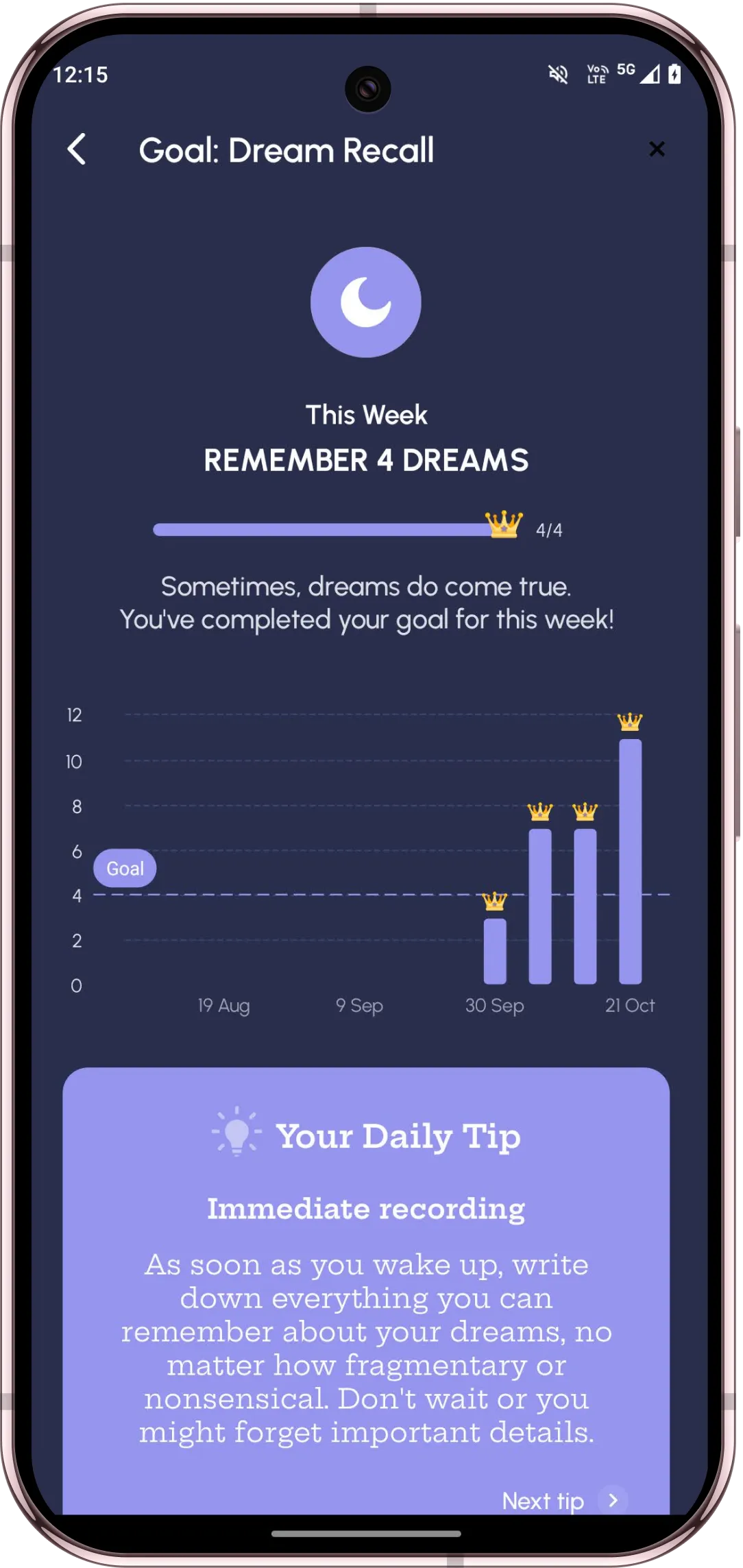
Your phone is usually what steals the dream. It can also save it, if the first thing it opens is your journal.
In Lucidity you can speak the dream when you're too sleepy to type, and a morning reminder brings you back to your journal. Dream recall is where its lucid dreaming program starts, because everything else builds on it. Your dreams stay on your phone, with no account needed.
Sources: Vallat et al., Increased evoked potentials to arousing auditory stimuli during sleep: implication for the understanding of dream recall, Frontiers in Human Neuroscience, 2017. Dement and Kleitman, The relation of eye movements during sleep to dream activity, Journal of Experimental Psychology, 1957.
Questions people ask
How can I remember my dreams?
Stay still with your eyes closed when you wake up and replay the dream, then write down whatever you remember before you check your phone. Do it every morning and tell yourself before sleep that you will remember. Most people remember more within a few days.
Why can't I remember my dreams?
Usually because of how you wake up: an alarm, getting up straight away or reaching for your phone. Short sleep, alcohol, cannabis and some medications also reduce REM sleep, where most dreams happen.
Do people who don't remember their dreams still dream?
Almost certainly. Everyone goes through several REM periods a night, and people woken during REM usually report a dream. Remembering is the part that differs.
Why did I suddenly stop remembering my dreams?
The usual causes are a new alarm or schedule, less sleep, stress, alcohol or cannabis, or a new medication. If it comes with other sleep problems, talk to a doctor.
Is it bad if I never remember my dreams?
No. Low dream recall is common and isn't a health problem by itself. It's simply a skill you can train if you want to.