Free tool · Updated
Wake back to bed calculator
Set your alarm about five hours after you go to bed, get up for a few minutes, then go back to sleep with a technique. Enter your times and the calculator plans the night for you.
When do you sleep tonight?
Set your times. Your alarm and the plan for the night update as you go.
Dream periodsDream periods after your alarm
Go to bed. Tell yourself once: tonight I'll notice that I'm dreaming.
Alarm. Get up without turning on the light. A sip of water, then sit quietly for 2 to 3 minutes. No phone.
Back in bed. Get comfortable and start your technique as you drift off.
Your lucid window. About 63% of tonight's dream time is still ahead of you.
Based on a typical night: 15 minutes to fall asleep and 90-minute sleep cycles.
How wake back to bed works
Wake back to bed, or WBTB, means waking up late in the night, staying up for a few minutes, and going back to sleep with a clear head.
It works because of where it puts you. You fall back asleep straight into the longest dream periods of the night, and your mind is awake enough to notice that you're dreaming. Most lucid dreaming techniques are built on top of it.
- Set an alarm for about five hours after you go to bed.
- When it rings, get out of bed.
- Stay up for a few minutes, calm and in dim light.
- Go back to bed and practice your technique as you fall asleep.
Why five hours
Sleep runs in cycles of about 90 minutes, and each cycle ends with a dream period, called REM sleep. The first one may last only a few minutes. Later in the night they grow to around an hour. The chart above shows it: the bars get longer as the sky gets lighter.
So the second half of the night holds most of your dreams. An alarm after five hours lands right before the long ones start. More about that in how REM sleep works.
The research uses the same timing. In the International Lucid Dream Induction Study (2020, 355 participants), everyone set an alarm five hours after going to bed, got out of bed to turn it off, and practiced their technique before going back to sleep. One finding stands out: on nights when people fell back asleep within ten minutes of finishing their technique, they had a lucid dream 18% of the time, against 11% when it took longer. So don't wake yourself up too much.
What to do when the alarm rings

The goal of those minutes is to wake your mind a little while your body stays sleepy. How long that takes differs between people, and guides suggest anything from a few minutes to an hour. Start short. If you then drop straight into ordinary sleep and nothing happens, stay up a little longer, or turn on a light for a minute.
Back in bed, lie the way you normally fall asleep and start your technique. With MILD you repeat your intention to notice the dream. With SSILD you cycle through sight, sound and touch.
Wake back to bed alarm times by bedtime
For a quick answer without the calculator: five hours after you go to bed.
| You go to bed at | Set your alarm for | Back in bed by |
|---|---|---|
| 9:00 PM | 2:00 AM | 2:05 AM |
| 9:30 PM | 2:30 AM | 2:35 AM |
| 10:00 PM | 3:00 AM | 3:05 AM |
| 10:30 PM | 3:30 AM | 3:35 AM |
| 11:00 PM | 4:00 AM | 4:05 AM |
| 11:30 PM | 4:30 AM | 4:35 AM |
| 12:00 AM | 5:00 AM | 5:05 AM |
| 12:30 AM | 5:30 AM | 5:35 AM |
| 1:00 AM | 6:00 AM | 6:05 AM |
What goes wrong
Most failed attempts come down to being too awake or not awake enough.
- Waking up completely. Bright light, a screen or a long read and you're simply awake.
- Checking your phone. One notification and the night is over.
- Not getting up at all. Turning off the alarm and rolling over is just sleeping. Stand up, even briefly.
- Trying it on a short night. With six hours of sleep there is little dream time left after the alarm. Pick a morning you can sleep in.
- Going back to bed without a technique. The awakening opens the door, the technique walks you through it.
Let Lucidity run it for you
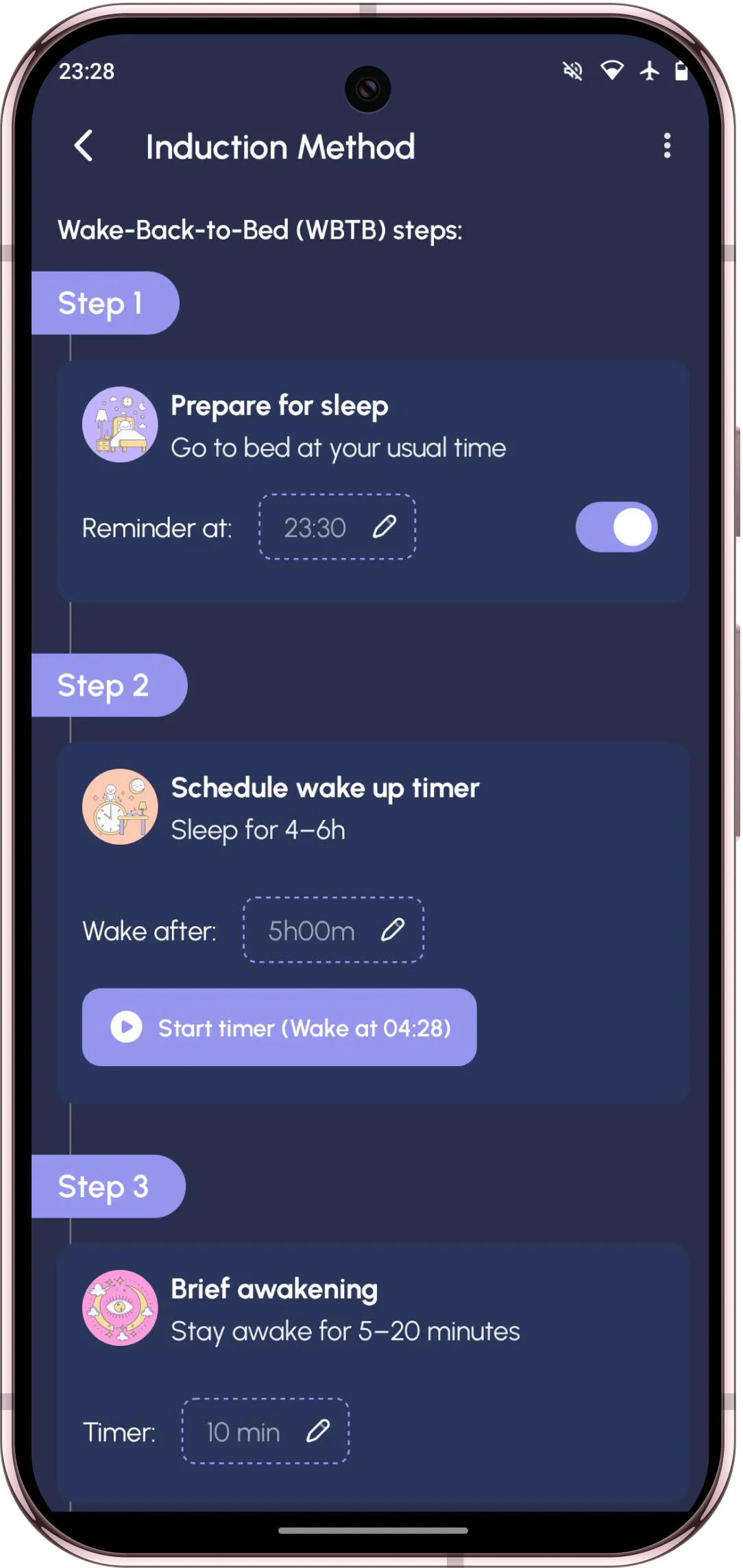
Lucidity has the most complete wake back to bed of any dream app. It calculates the alarm from your sleep time, reminds you at bedtime, wakes you, times the short awakening and then guides the technique you chose.
The setup is interactive and takes a minute. After that you only have to go to bed.
Source: Findings from the International Lucid Dream Induction Study, Frontiers in Psychology, 2020.
Questions people ask
What time should I set my wake back to bed alarm?
About five hours after you go to bed. If you go to bed at 10:30 PM, set it for 3:30 AM. Anywhere between four and six hours works, and the calculator on this page finds your time.
How long should I stay awake during wake back to bed?
Advice ranges from a few minutes to an hour. Start short: get up, drink some water, sit quietly for a few minutes and go back to bed. If you then fall asleep instantly and nothing happens, stay up a bit longer next time.
What if I can't fall back asleep?
Shorten the awake period and keep the lights and your phone off. Staying up for five minutes at most, away from any screen, makes falling back asleep easy for most people.
Does wake back to bed work on its own?
It works best with a technique. Use the awake minutes to set your intention, then practice MILD or SSILD as you fall back asleep.
Is wake back to bed bad for your sleep?
A short awakening costs you a few minutes. In a 2020 study with 355 participants, people who succeeded at inducing lucid dreams reported no drop in sleep quality. Pick mornings when you can sleep in.